Training for new Fritz Winter plant in the USA
- The Fritz Winter iron foundry officially opened its new U.S. headquarters in Kentucky with its first production line on Oct. 26, 2017. Among other things, brake discs for US car companies will be produced there. 20 newly recruited US employees for production there were intensively trained in advance at the main plant in Stadtallendorf using the train-the-trainer method. As multipliers, they are to pass on the know-how they have acquired to future US employees at the new site. The basics were a targeted familiarization program and optimal teamwork.
Nearly 7,500 kilometers separate Stadtallendorf in Hesse from the new Fritz Winter Drive in the Wilkey North industrial park near Franklin/Kentucky, just under an hour's drive north of Nashville/Tennessee, the center of US country music. There in the greenfield USA, Fritz Winter Eisengießerei GmbH & Co. KG built the first section of its new plant: a state-of-the-art foundry with mechanical machining and an annual capacity of more than 60,000 tons of iron castings was created on an area of around 25,000 square meters. According to Jörg Rumikewitz, Chairman of the Management Board at Fritz Winter, the favorable location between the European automotive manufacturers in the south of the USA and the US manufacturers in the north offers an excellent starting position. The iron foundry is paying a high price for this: After all, they are investing more than 100 million euros in the first phase of the new building, and they want to employ 300 people there in the first stage. In order to build up a fresh, well-qualified workforce far away, Fritz Winter is taking a completely new approach: The first 20 newly hired US employees for production were intensively trained for their future workplace at the main plant in Hesse using the train-the-trainer method: They are to act as multipliers at home, passing on their company-specific know-how acquired at the respective production stations in Stadtallendorf to the future US employees. "These employees are our personnel starter kit for the U.S., so to speak," says Firat Saritekin, industrial foreman and head of the molding shop, who is also the technical lead for the U.S. project.
Language barrier quickly overcome
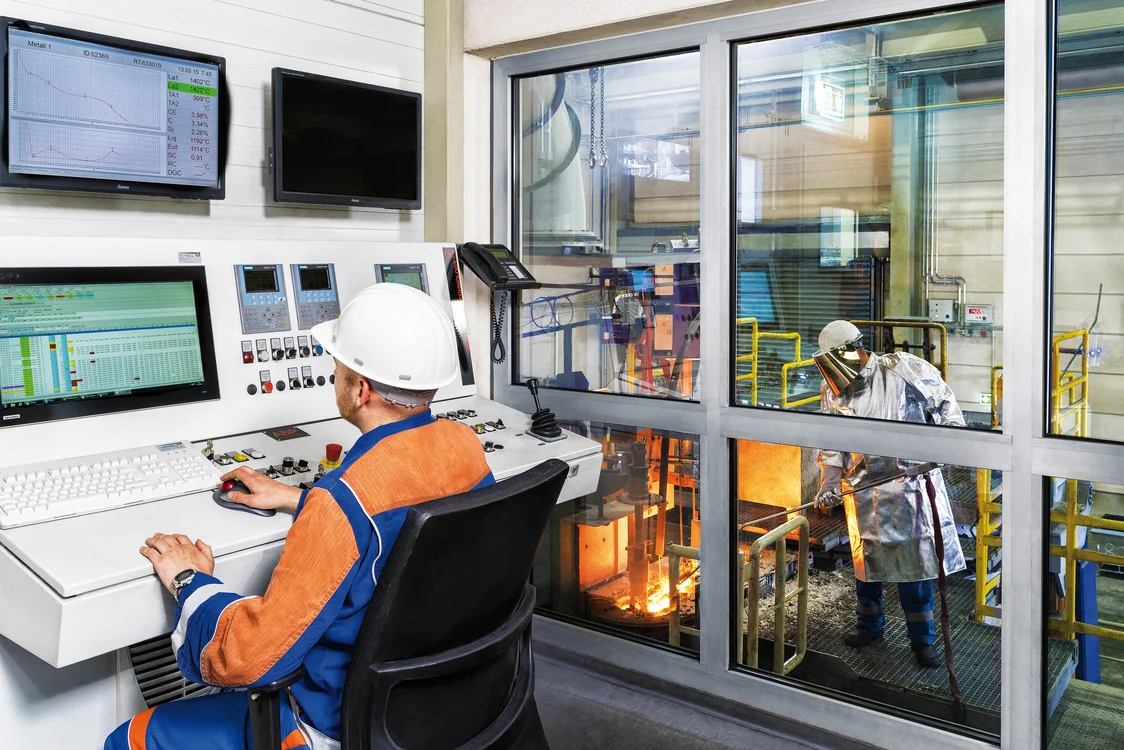
To this end, mentorships have been established here: 30 mentors, experienced Fritz Winter production employees, look after the newcomers, who are to work overseas in the areas of skilled foundry worker, pattern maker, electrician, mechatronics engineer or CNC miller and later guide the new US personnel on site, for example as team leaders. One of them is Dennis Presly, who is acquiring knowledge in monitoring and control at the casting furnace control station during his three months at Fritz Winter: "I think it's great that I can take a whole lot of new experience with me across the big pond." Right at the beginning, however, there was a major hurdle to overcome: "At first, we stumbled over the language barrier, especially when it came to foundry jargon," Saritekin recalls. But after overcoming the initial fear of contact and a bit of small talk to get things started, communication got better and better, even if they often used cell phones and dictionaries to help each other communicate in the beginning. Shawn Simmons and John Shannon Burton are also looking forward to their new commitment at Fritz Winter in Kentucky: "Above all, we were surprised at how well the teamwork works here," say the two, who previously worked in a U.S. aluminum foundry where, among other things, automotive stabilizers were manufactured.
When asked what prompted them to join Fritz Winter, they say: "Fritz Winter is the number one in the industry and such an opportunity to build a new production line from scratch is unique. They were also pleasantly surprised by the high level of safety in German plants, even if the production software is somewhat more complex than domestic solutions. The new starter team is all male. "Of course, the work is rougher in our smelting operation in particular than in other areas, but there are many men who particularly like this rough work, the handling of molten iron," explains Andreas Fiedler, human resources manager at the Fritz Winter iron foundry in Stadtallendorf. It is therefore quite fitting that a relatively large proportion of the new U.S. colleagues come from the aluminum casting industry, which is quite common in Kentucky.
Introduction with a system
To ensure that the induction process also runs smoothly, the mentors had initially drawn up a detailed training program together with the division managers. This included rules of conduct translated into English, safety instructions, and work instructions showing, for example, how to safely operate the molding machine or change over models in practice. After all, the molding plant used in America is identical in design to the one in Stadtallendorf. Behavior in the event of fault conditions was also intensively trained. "In this way, our new US colleagues can take a lot of knowledge with them to their future workplace," says molding shop boss Saritekin. In addition, there were block courses at the Association of German Foundry Specialists (VDG) and the acquisition of formal licenses, such as crane or forklift operator licenses. Finally, at the end of each training unit there was a so-called "feedback sheet" in which the skills of the newcomer were certified. A dual training system, as has been established and proven in this country for decades, is rather unknown in the USA. Here, people usually work their way up through the ranks to team leader, coordinator or supervisor. "Well thought-out induction plans have been a great help in training our new staff in a targeted manner," confirms Melanie Wagner, who is responsible for the induction program in the HR department: "After all, we didn't know exactly what to expect beforehand. In retrospect, however, we can say that all new colleagues have understood how to take advantage of the opportunities and that our strategy has proven itself."
Alan Morrison from the core shop feels the same way - with 28 years of foundry experience, he is something of a senior among his US colleagues. He, too, sees the good teamwork at Fritz Winter as a big plus compared to many U.S. companies. "After all, you can't do a good job without enjoying your work," Morrison says. His mentor, Michael Mai, feels the same way and adds that the new employees have taken everything in quite eagerly. What's more, he says, it was a win-win situation, because the German colleagues were also able to brush up on their language skills through exchanges with their new colleagues and, not least, benefit from the Americans' wealth of experience. To prevent them from feeling homesick in the first place - almost all of the U.S. colleagues have families at home - there were extracurricular activities after work. The families of the German colleagues were also involved. The program included bowling, handball and billiards, as well as a visit to a U.S. World War II memorial. "In this way, we ultimately also improve international understanding," says a pleased Niclas Ruhl, industrial foreman specializing in casting, fettling and sponsor at the molding plant. The only thing that core maker Alan Morrison missed a little was the orange-flavored Blue Moon beer from his native Kentucky.
US colleagues help with setup and commissioning
A lot of work awaits the newcomers at the new US headquarters in Kentucky, anyway. There, the new Fritz Winter plant is slowly taking shape: Currently, the new molding machines are already being set up, casting lines are under construction and the new furnaces are still packed in the new hall, as are the machines for mechanical processing or even the fettling shop. "After their return, the new colleagues will help with the set-up and commissioning of the new equipment - all tried-and-tested foundry technology of the kind used in Stadtallendorf," says Jörg Schurich, project manager for Fritz Winter's U.S. personnel. And the mentors and other Fritz Winter workers also accompanied the production startup in Kentucky for about five months starting in early summer. The first production tests were then scheduled to start in the summer, and the first machined castings were to be produced in small quantities by the end of the year. "The construction of our new plant in Franklin is an important milestone in our globalization strategy," explains Fritz Winter CEO Jörg Rumikewitz: "The advantage for us there is the central location in the east of the USA and thus the proximity to our customers, plus the availability of a highly qualified workforce and the excellent local infrastructure." This is increasingly important to meet the flexible needs of automotive customers, he said. "In this way, we are further consolidating our position in one of the world's most important automotive markets," adds Henning Knipper, who works in corporate development at Fritz Winter.
It's all about iron-cast brake discs with extremely tight tolerance requirements, which should also guarantee Fritz Winter a profitable business in the electromobile car future. This is because the foundry from Stadtallendorf, not far from Marburg, is almost 100 percent dedicated to vehicle construction with products such as brake discs, engine blocks and cylinder heads. Its customers include almost all the major players in the automotive, commercial vehicle and hydraulics industries. An annual melting capacity of 1,000,000 tons of molten iron, more than 25 million castings and a turnover of around 650 million euros are convincing arguments for calling itself Europe's largest independent foundry. However, things don't really get going at Fritz Winter USA until 2018 after production has ramped up to full capacity. "We are looking forward to our future in Kentucky," is how Jörg Rumikewitz sums up his expectations about the new location.
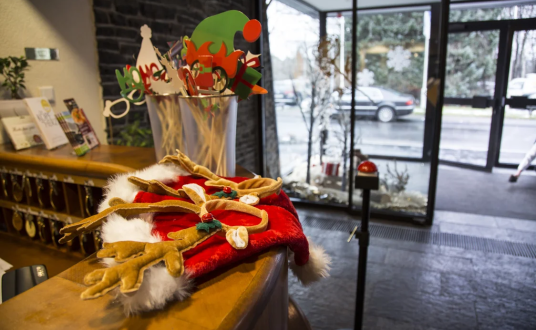
Advent craft afternoon for our employees' children
Craft afternoon with a visit from Santa Claus for our little Winterians.

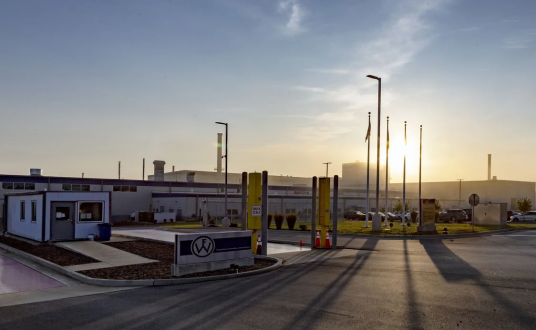
Success that can't be stopped.
One milestone follows the next. Just one year after the groundbreaking ceremony, Fritz Winter's US plant was officially opened. Now the millionth brake disc has rolled off the production line there.
Training day 2019
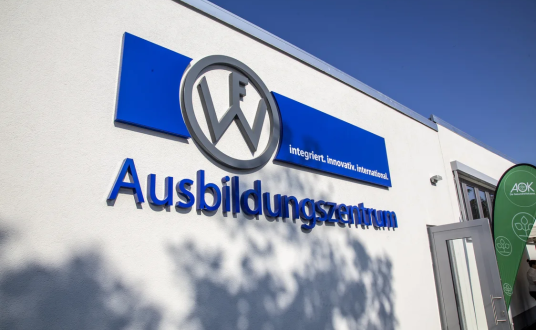
The 13th Apprenticeship Day at Fritz Winter took place on 31.08.2019. The event serves to present the company and its diverse training opportunities to students, their families, teachers and all other interested parties. As the largest training company in the region, our goal is to give our trainees a good start to their careers.

